
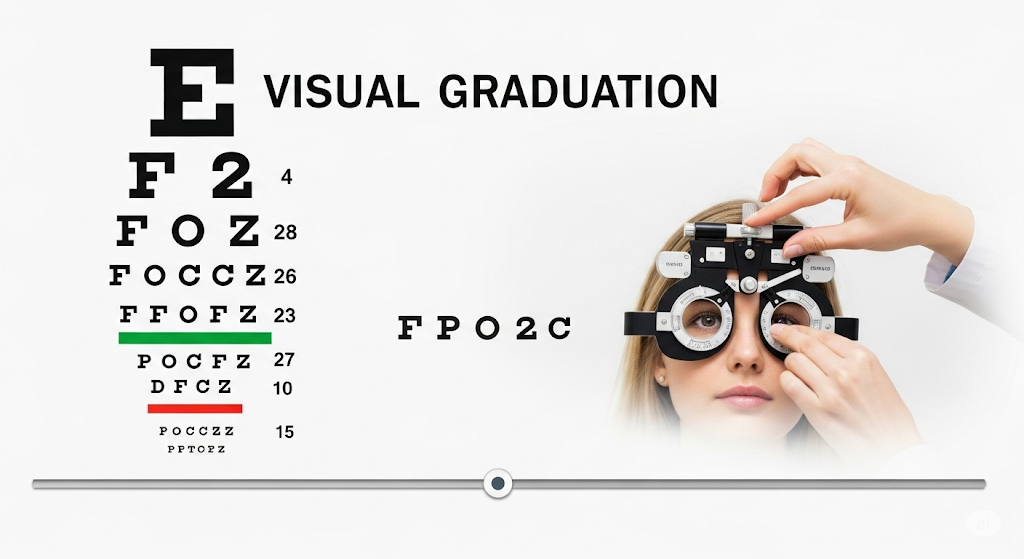
Eye test
The basis of good vision is a good prescription. Comprehensive checkups with state-of-the-art technology.
An eye exam is the result of a test or analysis of the vision in each eye that indicates the optical correction for each one.
With an eye exam, you can solve problems such as nearsightedness, farsightedness, astigmatism, or eyestrain.
How is visual acuity tested?
First, a short interview:
One of our eye care professionals will ask you a few questions: Can you see well from a distance? Do you have trouble reading up close? Do you experience headaches or eye strain? This helps us understand your needs and possible symptoms.
Initial measurement (objective):
We use a device called an autorefractometer, where you simply look at an image (such as a small house at the end of a road). This device gives a preliminary idea of your prescription, although it is not definitive.
Personalised (subjective) review:
This is when the famous test with letters and lenses begins. We will change the lenses and ask you, ‘Is it better this way or that way?’ This is how they fine-tune the exact prescription for your vision.
Near vision check-up and possible presbyopia:
If you are over 40, we will also check whether you need correction for reading up close. This is where addition (ADD) comes in, which is used to make progressive or bifocal glasses.
Initial measurement (objective):
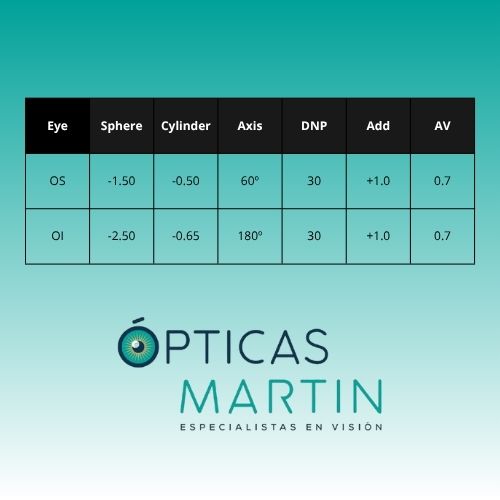
If necessary, the cylinder (CIL or CYL) and axis (AXIS) are also measured, which correct astigmatism. Both work together to fine-tune your vision, like adjusting the sharpness on a camera.
Personalised (subjective) review:
This indicates how well you see with the appropriate correction. Perfect vision is usually expressed as 1.0 or 100%, although some people can reach 1.2 (eagle eyesight!).
And what data is the visual acuity based on?
OS y OI (RE or LE in English):
They are simply abbreviations for right eye (RE) and left eye (LE).
ESF or SPH (Sphere):
It measures whether you have myopia (–) or hyperopia (+).
CIL / CYL (Cylinder):
It’s for astigmatism.
AXIS:
Complements the cylinder, indicating the orientation of astigmatism.
ADD (Addition):
If you need help seeing up close, it is usually a positive number.
VA (Visual Acuity):
How well you see with correction.
Frequently asked questions
How long do I have to go without my contact lenses to get my eyes tested?
To ensure that your eye test is accurate, you must stop wearing contact lenses at least 12 hours before the test.
What is normal vision?
Standard vision or ‘visual acuity’ is measured at 20/20 or 6/6 in metric units. In simpler terms, a normal person can read from a distance of 6 metres.