
Myopia control
Proven results. We safely slow down myopia.
What is myopia?
Myopia is a refractive error that causes nearby objects to appear clear but distant objects to appear blurry.
This occurs because light rays focus in front of the retina, rather than on it, due to the eye being too long or the cornea being too curved.
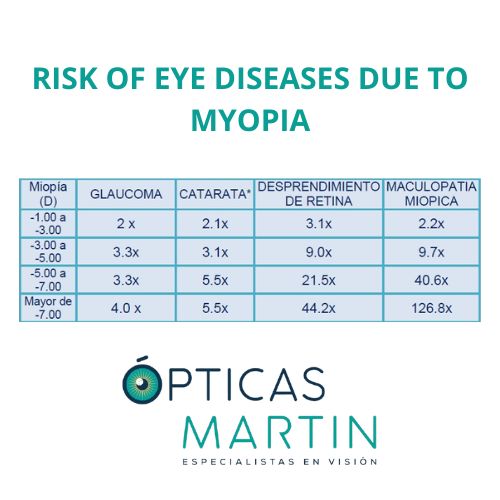
Treatment options for myopia
Ophthalmic lenses
They are like your regular glasses, but designed to reduce strain on your eyes and slow down the progression of myopia.
Soft lenses for myopia control
They are glasses with lenses that help your eyes work more efficiently while slowing down myopia.
Orthokeratology
Put in special contact lenses before going to bed and the next day… clear vision without glasses or contact lenses.
Causes of myopia
Axial length of the eye
If your eye is slightly longer than normal, images focus before reaching the retina and you see blurry from a distance.
Curvature of the cornea or lens
Think of the front of your eye (the cornea) or the internal lens (the crystalline lens) as a camera lens. If they are slightly more curved than they should be, the light is deflected too much and the image is not clear.
Genetic factors
Sometimes, short-sightedness runs in the family.
Lifestyle
Nowadays, we are glued to screens and books. This constant “close work” and lack of time outdoors can be a trigger for myopia to appear or increase.
Frequently asked questions
How is myopia controlled?
Myopia can be controlled using glasses, contact lenses or orthokeratology contact lenses.
Can vision lost due to myopia be restored?
Currently, there is no cure for myopia, but it can be slowed down and controlled with treatments prescribed by an eye care professional.
At what age should myopia control begin?
Controlling myopia early is vital and should begin at age 6, as this is when myopia progresses most rapidly.